KIGALI, Rwanda – I stepped off the plane and into an African nation the likes of which I’d never seen.
“Please sanitize your hands,” were the first words I heard as I entered a surprisingly small terminal at Rwanda’s Kigali International Airport
The polite airport employee, a smartly dressed young woman, pointed to a pair of antiseptic dispensers fastened to each side of the single entrance door. I obliged.
Just beyond, a second surprise – my first glimpse of “Urmuri.”
A robot resembling a modern version of R2-D2 of Star Wars fame shuffled about like a Disney theme park character in the role of a welcoming host.
I later learned Urmuri was programmed to take my temperature. Dating from the COVID days, it’s the Rwandan government’s way of monitoring the health of every visitor.
Another shock: Immigration was a breeze. A cell phone screen shot of my pre-paid visa and a quick background check sent me through in less than a minute. [A week later, it would take me an hour – and $144 cash – to clear customs in Zanzibar.]
The last surprise topped the first three.
As I approached customs, I was stopped by another airport employee who pointed at the bag carrying my duty-free goods.
“Excuse me, sir. You’re not allowed to bring plastic bags into Rwanda.”
I was so astonished I asked her to repeat it.
Confirmed. Into a recycling bin went my plastic sack.
In a span of around 10 minutes, everything I’d heard about modern-day Rwanda appeared to be true.
I say appeared because 32 years earlier an unimaginable race war snuffed out the lives of 800,000 members of the country’s minority population. Deep scars from that conflict had to be present, I thought, and wondered: Is it possible those dark days could return?
I also had some questions about the man credited with ending the genocide and rebuilding the country. Paul Kagame has led Rwanda since 1994 and won four straight elections, garnering more than 90 percent of the vote each time
That number – and the years in office – piqued my curiosity as it felt like an electoral autocracy to me.
I had much to see and learn during my visit to what is billed as Africa’s most progressive country. But in my experience reporting from so called ideal countries on every continent, I’ve found that if something is too good to be true it usually is.
Why Rwanda?
I decided in March to hone in on Rwanda as possibly my next destination.
Everything I knew came from two movies – “Gorillas in the Mist [1988],” and “Hotel Rwanda [2004].” The first one depicted the life of Dian Fossey, who was murdered in Rwanda in her quest to save the country’s declining mountain gorilla population. The second focused on the genocide mentioned above.
Some early research increased my interest as it appeared the Rwanda of the past was not the Rwanda of the present.
I called my source in such matters, my cousin Allison Abraham. Last year, she suggested Mongolia for a reporting trip, a country I never considered. I went. Bingo! A winner.
As for Rwanda, I knew Allison, an internist at a Portland, Ore. hospital, had considerable experience in neighboring Kenya, where for years she has voluntarily directed a mentoring program for medical students. As usual with us, there was a synchronous moment during our conversation:
Me: I’m thinking about Rwanda.
Allison: I’m headed there in May.
Me: No way!
Allison: Way.
Me: What do you think?
Allison: Go. It’s supposed to be really good now. You’ll find great stories.
Me: I’m there.
Soon after, I visited my old friend Tom Kattar of Jupiter, Fla., who served as my wing-man on the Mongolia trip. Last year, he had to talk his way into joining me as I always traveled solo.
This time, the conversation lasted about 10 seconds.
Me: I’m going to Rwanda.
Tom: I’m in.
That news triggered a To Do list that took three months to complete. By the time I walked out of the Kigali airport late on a pleasant summer night and met my driver/guide/interpreter, Jonas Nengiyumva, for the first time, I was ready to chase my stories.
The Tour
The next afternoon, a Sunday, Tom and I met Jonas near the apartment we rented on the fringe of Kigali’s business district. We assumed we’d be touring the capital city by car. Not so, said Jonas, a 30-year-old entrepreneur who escaped poverty as a youth thanks to the kindness of a Spanish tourist who invested in his future.
“Parking is nearly impossible, and we’ll be moving from place-to-place.”
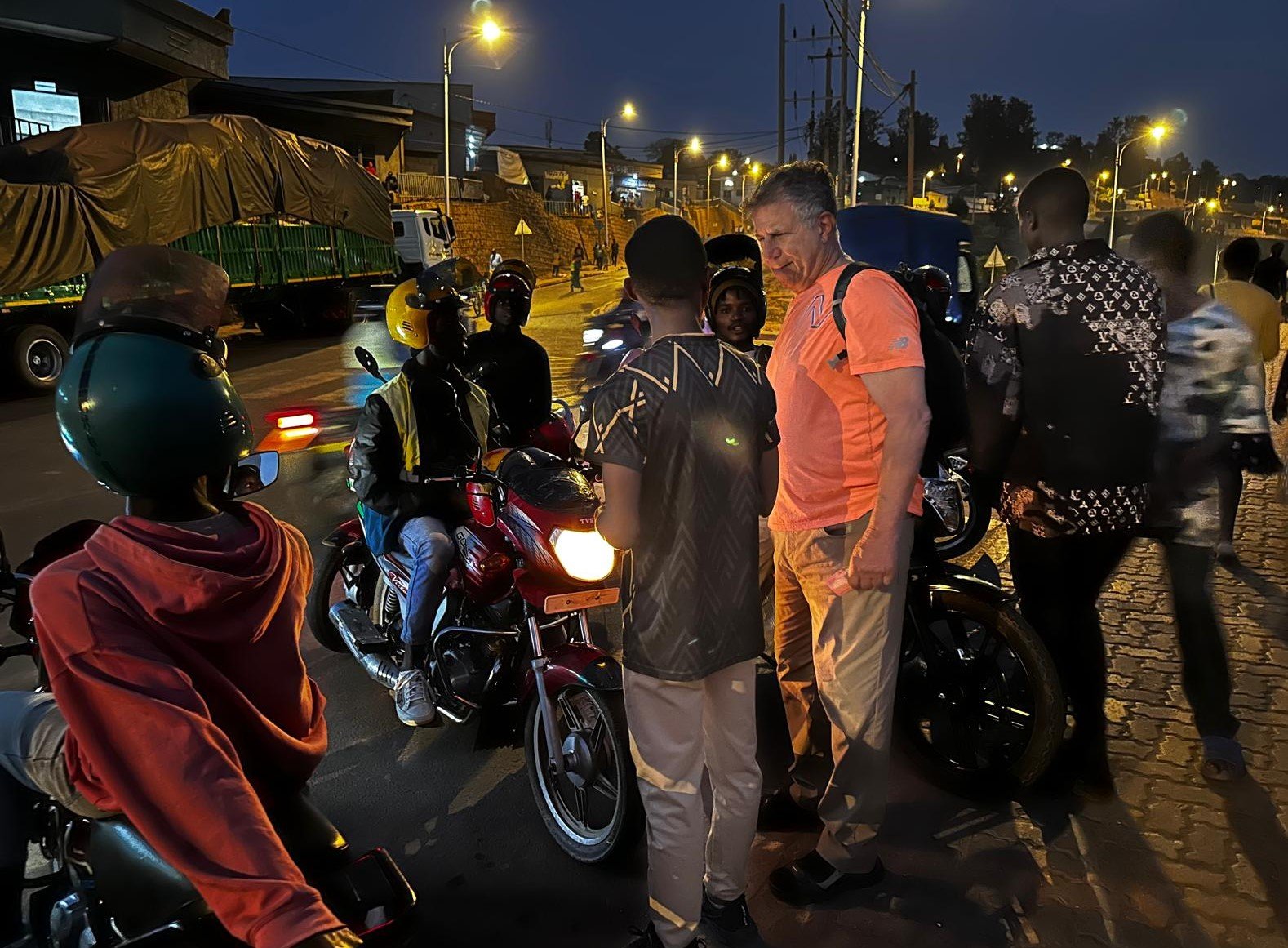
Jonas snapped his fingers and out of nowhere appeared about a half dozen young men on small motorcycles, called “moto taxis” here. After a quick negotiation – the going rate is 66 cents per ride – the chosen drivers handed us three helmets. We hopped on back and off we went, zipping in and out of traffic as thick as Chicago’s yet not as busy as a typical Kigali work day, Jonas said.
Along the way, before our first stop, I took in the view. The city is perched on a series of steep slopes, elevated ridges and valleys, with an average altitude of around one mile – the same as Denver. As with most African capitals, high-rise buildings clog the center, residential neighborhoods the perimeter. The wealthy live in walled compounds; the poor in single room, metal-roofed, concrete shanties lining dirt roads filled with potholes. In these neighborhoods traffic is not an issue. No one can afford a vehicle of any kind.
Three mostly forest-covered mountains surround the city, a preview to the rest of the land-locked East African country about the size of Maryland. The “Land of a Thousand Hills” is aptly named because the entire country consists of rolling hills, green mountains and fertile valleys.
Amazingly, as I had been told, every street, sidewalk, alley, shopping center and neighborhood had not a single piece of litter. It could have been Switzerland, Norway or Singapore – each noted for their cleanliness. But a developing African nation? To me – I’ve visited 24 of them – that seemed impossible.
“Cleanliness is part of our heritage,” Jonas said over lunch. “But after the genocide the government developed a clean-up program to create jobs.”
Sanitation crews are assigned sections in every city, town and village. Beginning at 6 a.m. each day, they wield their straw brooms and rubbish sacks to sweep the streets and collect any lingering trash or debris.
The centerpiece of the program is a nationwide cleanup day on the last Saturday of each month called “Umuganda” [oo-mu-gan-duh] that unites the country in a single cause stressing solidarity and community.
In summer, Jonas said, Umuganda coincides with the annual genocide-remembrance period that begins in April and lasts 100 days.
To me, the goal seems clear: While some countries bury their past atrocities, Rwanda has chosen to broadcast theirs as a never again exercise.
Moving On
As our lunch neared its end, we bounced from one topic to the next. I mentioned the office building construction projects I had seen. Chinese investments, Chinese laborers, Jonas said. India also is a major player in the Rwandan economy, and South Korea installed a 4G fiber optic mobile phone network almost 20 years ago that enabled Rwanda to leap into the future.
Surprisingly, Jonas said he has banked by phone for years. And national and local police departments operate a sophisticated network of surveillance cameras that nab traffic violators – who are notified by phone – and help deter more serious crime.
Interested in starting a business here? Again, thanks to technological advances and a streamline, business-friendly process, individuals can be off and running in as little as six hours – that’s not a typo. Approval to operate a more substantial business in one of the country’s Special Economic Zones can be completed in merely three days.
Another well-publicized success story has been the dramatic increase in the country’s gorilla population. Five decades of conservation efforts have seen the number rise from 200 to around 1,000. As a result, luxury gorilla trekking to their rain-forest habitat in Volcano National Park attracts thousands of tourists annually. Coupled with other attractions as well as Kigali’s reputation as a go-to location for conferences and conventions, Rwanda is banking around $650 million in tourism revenue every year. Along the way it has become Africa’s fastest growing visitor destination.
Jonas, for one, couldn’t be happier with this development.
“It’s the reason I’ve been able to grow my travel business,” he said.
Later, as our first day neared its end, a few blemishes emerged. Gas, I noticed, runs $8 a gallon, an astronomical number in a country where the average person earns a little over $1,000 a year. Car ownership is out of reach for more than 90 percent of the population. And Rwanda imports considerably more than it sells, spiking the cost of consumer goods.
As for that surveillance camera system: Apparently, it also helps those in power keep an eye on those who’d like to replace them.
Still, President Kagame remains a popular figure [unless you’re a member of the muzzled opposition party.] In particular, he’s supported by the massive group of rural voters who comprise 72 percent of the country’s 15 million residents. They love the cleanliness program that provides them with jobs. They appreciate the health care system that comes with little or no cost. And they are proud of Rwanda’s network of newly paved highways even though the overwhelming majority of them get around on foot or bicycle.
Jonas said Rwandans in Kigali have a name for the roads that reach rural communities.
“We call them the 95 percenters, because they help the president get 95 percent of the villagers’ votes.”
By now night had arrived. We just completed a walking tour of Biryogo, Kigali’s version of the Plaka in Athens, minus the ruins – block after block of restaurants, cafes, artisan galleries and tourist shops with hawkers shouting, “Mr! Mr! Come here.” The place was packed with families enjoying their Sunday evening.
At the end of the street, we met a group of moto taxi drivers strategically positioned for evening action. Jonas negotiated our rides home. As we sped off into the darkness, I reflected on Day 1. As impressive as everything appeared, I couldn’t help but think that it all felt a bit fragile, as if it could all come crashing down one day.
Over the next five days, I’d get a closer look. But I already knew that perfect countries do not exist.
Editor’s note: Second in a series from a reporting trip to Rwanda and Zanzibar June 28-July 4.