KINIGI, Rwanda – I am a few blocks from the entrance to Volcanoes National Park in northern Rwanda, part of a tri-border shared with Uganda and the Congo. More than 50,000 tourists visit the park each year to, hopefully, spot a few members of its population of mountain gorillas – the world’s largest living primates.
I’m here tracking something else: Two men who used to kill them for a living.
The Saviour
On Dec. 26, 1985 a machete-armed assailant murdered Dian Fossey in her mountain cabin about 30 minutes from here. Fossey, an iconic American primatologist and conservationist, is credited with beginning the movement to save Rwanda’s gorilla population from extinction by poachers.
In the pre-internet/social media era, Fossey was an international phenomenon. National Geographic underwrote much of her research and promoted her work in its magazine, which had 12 million subscribers at the time. Three years after her death, Hollywood cemented her legacy in the film version of her best-selling memoir, “Gorillas in the Mist.”
At that point, in 1988, Rwanda’s gorilla population hovered around 280, up from a low of 240 in 1981. Among the primate conservation activists scattered about the globe, a critical question emerged: Who would take Fossey’s place?
The answer appeared 16 years later.
Edwin Sabuhoro had little in common with Fossey besides their mutual commitment to curtail gorilla poaching.
Raised in a Rwandan refugee camp in neighboring Uganda, Edwin endured extreme poverty and other hardships but possessed an intellect and ambition that eventually earned him a place at a prestigious British university. He planned on a career in law but switched to conservation and tourism, joining the game warden crew at the Volcanoes National Park as a 28-year-old.
In 2004, during routine patrols, Edwin and his colleagues noticed an uptick in gorilla carcasses left on the trails. When a source revealed the pending black-market sale of a baby gorilla, Edwin volunteered to portray a buyer in a dangerous sting operation. The ruse worked, and the sellers were sentenced to prison.
Although pleased he helped save the baby primate, he wondered why these men had risked so much to traffic an endangered species?
He found the answer in nearby communities where he visited the hunters: “They just needed to feed their families,” Edwin said during a 2025 magazine interview.
The experience led to life-altering decision.
“I realized that radical change was necessary to break the generations-long cycle of poaching.”
Edwin invested his savings – $2,000 – to rent land for a community of poachers and their families. Schooled by neighboring farmers, they planted potatoes. The fruits of several harvests, overseen by Edwin, had a dramatic impact. With a new reliable source of income, the poachers-turned farmers no longer needed to hunt gorillas. As a result, the primate population began growing to numbers previously thought unattainable.
But not all poachers wanted to become farmers. So Edwin conceived an alternative career path. He envisioned a tourism boom in Rwanda. With thousands of visitors flocking to the national park to see gorillas he assumed they’d be interested in the people and culture. He organized a series of workshops in the town of Kinigi on cooking, dancing and wood carving. The sold-out workshops led to the creation of a permanent venue: Gorilla Guardian s Village, a replica of a traditional Rwandan hamlet with multiple cultural activities directed and performed mostly by former poachers.
A number of hunters became wildlife guides, leading tourists along the very mountain paths where they used to hunt.
In a few years, Edwin managed to accomplish something that would have amazed Fossey: He turned gorilla killers into gorilla protectors.
The Farmer
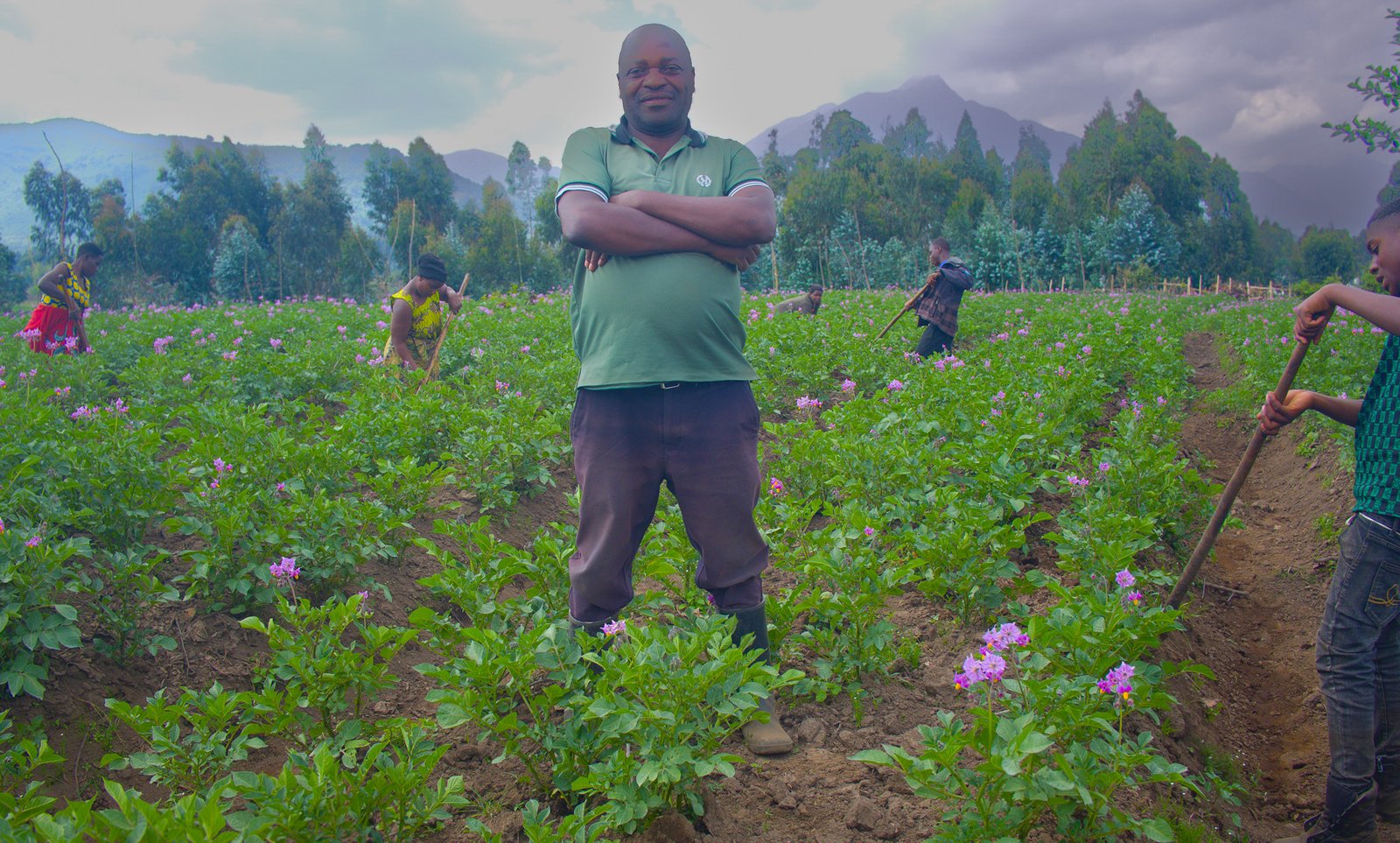
Two decades later I am standing in a 2.5-acre potato field directly connected to Edwin’s initiative. The farm’s owner, 57-year-old Francois Ndungutse, is a former poacher who became an early convert.
As he explained his cultivation methods, Francois directed five hoe-wielding employees whom he pays $3.50 a day to till the nutrient-rich, volcanic soil, among other tasks. Harvest is a month or so away.
He also rents two other plots totaling five acres, employing an additional 25 seasonal workers. In addition to potatoes, sold each season to local processing plants, Francois also grows pyrethrum, a natural insecticide and perfume ingredient. It’s a profitable cash crop exported worldwide.
He credits Edwin for not only changing his life but his community’s future as well.
“Even though he was a young man when he started this program, using his own money, he was like a parent to many of us. Everyone here respects him so much,” he said.
Earlier, as Francois and I sat in a courtyard surrounded by his simple village home and several outbuildings – all constructed with traditional mud bricks – he talked about hunting with his father and other family members as a teenager. They trapped antelope, wild pigs and buffalo, prized for their meat. Occasionally, they’d snare a primate but never intentionally, he said. Gorilla bushmeat, as it was called, was tough, stringy and considered unhealthy.
Yet, Francois on occasion attempted to sell his gorilla prey on the local black market, where friends of his were active peddlers. In those poacher heydays, live baby gorillas, primate skeletons and certain body parts fetched large sums.
In 2003, the government tightened its anti-poaching laws after a high-profile case sent three poachers to prison. Edwin turned up the following year to launch his farming plan, founding a cooperative to serve as a multi-layer support system. He provided seeds at his own expense.
Francois, already a respected community leader because of his communication skills and keen intellect, helped direct the new cooperative as he learned his new trade.
“I was not aware that I was destroying the environment. And I learned that all wildlife is important, not only gorillas,” he said.
Francois’ success has provided a better life for his wife, Dorothy, and their 12 children, aged 7 to 34. The oldest, Michael, is a veterinarian, an achievement never considered possible in the Ndungutse family. Although several of his sons have joined their father in the fields, Francois would rather they pursue college degrees.
A generation later, Edwin’s poachers-to-farmers plan has come to fruition in the communities near the park in surprising ways. For example, the Rwandan Development Board created a revenue sharing program calling for 10 percent of all national park tourism earnings to be distributed to adjacent communities for infrastructure, development and agriculture.
“Edwin started it,” Francois said, “But then the government got involved with different [conservation] programs. So, you could say they worked together to make everything good for us.”
The Village Kahuna
My next stop: The entrance to Gorilla Guardians Village, Edwin’s other pet project
If you’ve visited Colonial Williamsburg in Virginia this is Rwanda’s version of its past come to life.
On a day with few tourists, I was greeted by five spear-toting warriors. We entered the village together in a rhythmic dance. Sam Mukanzi, a 24-year-old guide, led me on a brief journey through the village detailing Rwanda’s cultural history. An herbalist explained which plants cured which ailments. A young woman, utilizing a rock and stone mortar, demonstrated the grueling task of grinding wheat to flour. I was offered a taste of Rwanda’s unique banana beer [urwagwa] – and politely declined. Seemingly of out nowhere, a reenactment of a traditional wedding ceremony broke out. The bride, dressed in a colorful wrap, was paraded around the village common sitting inside an elongated, canoe-shaped basket carried by four men.
The best performance belonged to a short, almost toothless 87-year-old man who called himself Barora. He told his story in a fast, rap-like chant – boasting of slaying 30 elephants during his poaching days before his rehabilitation. He then demonstrated his still-impressive hunting prowess by launching arrows from an antique bow into the center of a makeshift target.
The tour completed, I met the Village’s director, John David Mukiza. Like Francois in the farming program, he joined Edwin from the start. At 29, he was one of the five original poachers Edwin personally trained to oversee growth of the village. He has been in charge here for 13 years.
The Village’s success can be measured in a number of ways, he said. All the employees are former poachers or from poaching families. They are now called conservationists, which is why the Village includes Guardian in its title.
To pay for the programs, all net income from the Village is distributed to reformed poachers through a network of 10 cooperatives.
John David saved the big news for last: In the 22 years since the Village opened and the poachers-to-farmers campaign began, the gorilla population here has jumped to around 600.
The African Wildlife Foundation said Rwanda’s feat is widely recognized “as one of the greatest wildlife conservation stories in modern history.”
This success has led to a significant problem. The rainforest where the gorillas live can’t accommodate their increased numbers. So the government has implemented a controversial plan to relocate families living in sections of the park where the gorillas would thrive.
“Although they are being compensated, going to a new place will be challenging for these people, especially older ones,” John David said.
“But, for me, as a true conservationist, I think it is a good idea because these gorillas are bringing much revenue to the country.”
Before departing, I asked if visitors to the Village, some of whom completed treks to Dian Fossey’s gravesite, were aware of Edwin’s role in the gorilla-conservation movement.
“Oh, yes,” he said. “They always ask me: ‘Where’s Edwin? Can we meet him?’”
More Work Required
I had trouble tracking down Edwin myself.
We finally connected by phone in early June, several weeks before my trip to Africa. I assumed he was still working in Rwanda. But he told me he was spending the summer in Uganda, advising the country’s tourist association as well as continuing his life-long research. Aside from the 600 mountain primates living in Rwanda, another 400 or so reside in the neighboring rainforests of Uganda and the Congo.
“I’m still studying gorillas,” he said. “But my focus is more on the human side. How people can live and co-exist with them.”
Now 50, Edwin views Rwanda’s growing space problem for the primates as a positive.
“Nobody thought the gorillas would bounce back,” he said. “It shows us that if you all work together we can achieve something special.”
Edwin’s other focus is educating the next generation of conservationists. In that regard, he shares his knowledge with students at Penn State University, where in the College of Health and Human Development he’s known as Dr. Sabuhoro.
The continued threat of species extinction, such as East Africa’s black rhino, climate change’s impact on wildlife and poaching are problems he hopes his students eventually will solve.
For all his achievements, Edwin clearly is not comfortable in the realm of self-promotion. Quiet hero probably best describes the man to those who have witnessed him at work.
I asked how he viewed his predecessor, Dian Fossey. Without hesitation, he said: “Her work and dedication and commitment guided us. We will continue our work to honor her legacy.”
Editor’s note: Fourth in a series from a reporting trip to Rwanda and Zanzibar June 28-July 4.