KIGALI, Rwanda – The moment you enter the Kigali Genocide Memorial you feel the weight of a sadness so real it’s as if you are attending a family funeral.
In fact, the grounds are a tomb for 250,000 men, women and children – massacred in a 1994 ethnic uprising that claimed up to an additional 550,000 lives.
Once inside, there’s no escaping the reality of what happened in Rwanda three decades ago.
The question is why.
The answer can be found in a tiled-roofed building that looked more like an upper-crust Rwandan home than a museum housing an exhibit that tells the story.
I stepped inside.
Divide and Rule
Rwanda’s bloody history unfolds along a narrow, S-shaped hallway with dimmed light and black walls. The exhibit, consisting of photos, newspaper clippings, posters and documents, runs the length of one side.
It begins with Rwanda’s colonization, first by Germany in 1894, then Belgium in 1916.
Unlike many Sub-Saharan African nations, Rwanda’s population consists of two closely-related ethnic groups that share the same language and culture. The majority Hutus [85 percent] were mostly farmers; the minority Tutsis [14 percent] raised cattle. They co-existed peacefully for centuries.
The Belgians changed that.
To maintain control and prevent unified revolts, they granted the Tutsis favored status, believing them to be racially superior to the Hutus. Their leaders were gifted symbolic titles and prime government positions. In the early 1930s ethnic I.D. cards were issued for each group, labeling the Hutus as second-class citizens and turning their former Tutsi brothers into despised foes.
The Massacre
The majority Hutus remained oppressed for three decades. In 1957, Belgium, tired of the Tutsi’s clammer for increased authority and eventual independence, switched its support to the Hutus and armed them.
Two years later, the Hutus rebelled against the Belgians and forced 150,000 Tutsis to leave the country. By 1962, the Hutus successfully achieved an independent Rwanda. They appointed one of their leaders, Grégoire Kayibanda, president and began a systemic campaign to eliminate the Tutsi population. By the late ‘60s half of them had fled the country, the majority to neighboring Uganda and Burundi. Thousands were murdered before they could leave.
In 1986, Rwanda exiles living in Uganda organized the Rwandan Patriotic Front [RPF]. Led by the highly disciplined and ruthless Paul Kagame, Tutsis dominated the group. Four years later, they crossed the border to launch a campaign against the Rwandan army. The army responded by forming and training a citizens’ militia of Hutus to thwart any gains made by the Tutsis.
Fighting between the two groups escalated over the next few years. The tipping point involved the country’s second president, Juvénal Habyarimana, a former army general and Hutu, who replaced Kayibanda in 1973.
In late 1993, Habyarimana, a dictatorial ruler, signed a peace accord with Kagame’s group that would allow Tutsis in exile to return home and the promise of a power-sharing government. But when Hutu extremists opposed the accords, Habyarimana delayed initiating the pact.
On April 6, 1994, as Habyarimana returned from a peace accord meeting in Tanzania, his plane was felled by a surface-to-air missile, killing everyone on board including the president of neighboring Burundi.
That night, the Rwandan army and renegade Hutu militias issued a decree to their followers: Kill any Tutsi you see.
The slaughter began the following day.
The army used automatic weapons. The Hutu masses, many of them subsistence farmers, relied on their work tools – machetes and hoes – to massacre their defenseless enemy.
The level of violence was unimaginable.
In the museum, the photographs of the killings were so disturbing I had to turn away.
Tutsis who could not flee the country sought protection elsewhere. In Kibungo Province, 80 miles from Kigali, the capital, 20,000 Tutsis gathered at the Nyarubuye Roman Catholic Church, assuming they were safe. However, church leaders there and throughout the country were active Hutu supporters. The Tutsis were massacred, the church bulldozed with the bodies inside.
The speed and scope of the slaughter is impossible to fathom. It took 100 days to exterminate 850,000 people.
Despite the bloodbath, Belgium backed the Hutus but stayed out of the conflict. The U.S. under President Clinton pursued a non-intervention policy and declined to use the word “genocide” to describe what was taking place. The United Nations had peacekeeping troops on the ground in Rwanda but pulled most of them after 10 were killed. Only the country’s small Muslim population supported the Tutsis, offering refuge in their mosques.
It was left to Kagame and the RPF to stop the killing. They invaded Rwanda on April 8., setting off a full-blown civil war. Three months later, on July 4, the RPF captured Kigali. Surviving Hutu leaders were arrested.
Kagame took control of the country, beginning a remarkable rebuilding and healing process that continues today.
When I finished the exhibit, I thought about the short film I watched as an introduction to the memorial. It featured two survivors.
One of them, Theoneste Karenzi, then 16, recalled his family being herded into a sports stadium with hundreds of other Tutsis and watching as it turned into a killing field.
Just before his mother was shot, she turned to her son and said:
“If you have to die, die with dignity.”
The Survivors
The number of living survivors in Rwanda is difficult to confirm. Estimates range from 300,000 to 400,000.
Among them is Clemantine, a 43-year-old mother of six. We’re chatting in the sitting room of her three-room brick and mortar home in Rwarutabura, a high-density, low-income Kigali neighborhood featuring dirt roads, few cars and a lively, friendly vibe.
She was 10 when Hutus, armed with machetes, attacked her neighborhood in the first days of the slaughter.
“I only remember running and being separated from my parents and my [siblings].”
By chance, she encountered a government soldier who recognized Clemantine as the member of a Tutsi family who had gifted him a plot of land some years earlier.
“He told me he would pretend that I was his daughter,” she recalled.
The ruse worked. The soldier guided her to safety at an army barracks. Soon Clemantine and other survivors were evacuated to neighboring countries.
She spent six years in a refugee camp in Zaire.
By 2000, the conflict had long-since ended and Rwanda had stabilized under Kagame’s rule. Clemantine was 16.
“I wanted to return home,” she said. “To see if anyone in my family was still alive.”
Penniless, shoeless, and wearing the only clothes she owned, Clemantine set off on foot. It took her seven months to walk the 200 miles back to Kigali as she sought work along the way for food and shelter.
Soon after arriving she was saved again, this time by Vincent, a 29-year-old soldier who would become her husband. A Tutsi, he said he fought to stop the killings of his own people during the genocide when the majority of his fellow soldiers – Hutus – sided with the militias.
“It was very, very hard,” Vincent said. “And, then, while I was in a battle, I heard that my parents had been killed.”
Vincent’s losses made him sympathetic to Clemantine’s quest to find her family, an almost impossible task because thousands of victims were buried in mass graves scattered around the country.
Several years passed before she learned the truth. Her father was dead. So were his mother and father – Clemantine’s grandparents – as well as all 12 of their other children, her aunts and uncles. An older brother also did not survive.
That horrific news was softened by unexpected joy: Her mother, two sisters and another brother were somehow alive.
Clemantine and Vincent married in 2003, the same year their first child was born. They named her Divine. Another five followed; the youngest is now 6.
Today Clemantine runs her own business utilizing her sewing skills. Her work fully supports the family because Vincent had to quit the army in his mid-30s after a degenerative eyesight condition surfaced. Now 56, his vision is nearly gone.
Clemantine has managed to cope with her horrific past through her rebuilt family. Although her mother has passed away, her surviving siblings have a combined 13 children. Her six make 19. When they visit, she thinks: This is what it used to be like, being all together.
Still, TV programs during the country’s annual 100-day genocide remembrance period – known as “kwibuka” – can trigger dark memories.
“I get very emotional,” she said. “Then I remember how I survived and know I have to continue to be resilient for my children.”
Vincent regularly visits the genocide memorial. There, he feels close to his late parents and other family members, thinking it could be their resting place.
Clemantine refuses to join him.
“I can’t,” she said. “It would be too painful.”
The Forgotten
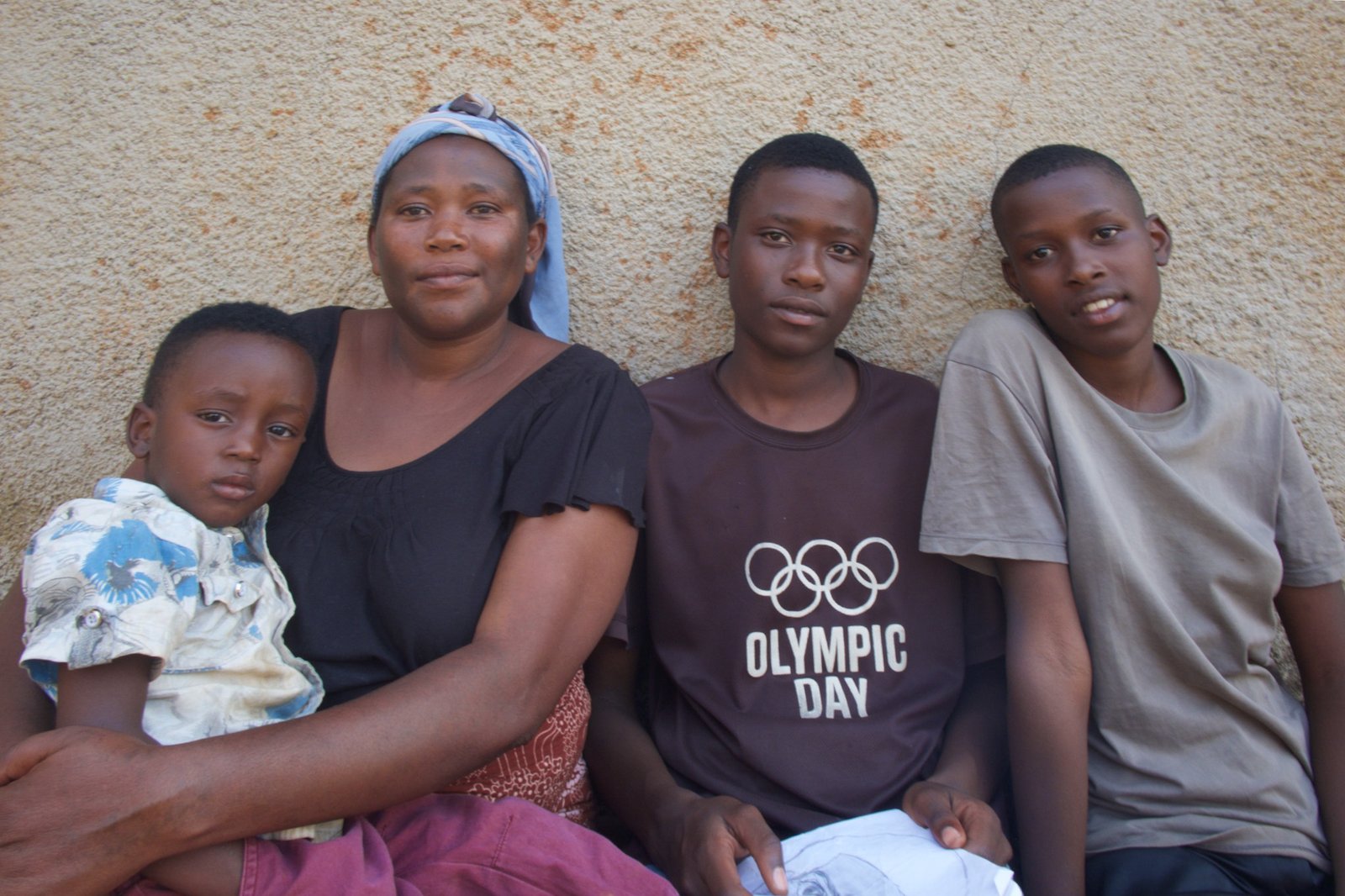
From Clemantine’s home I traveled two miles to visit a 40-year-old woman named Immaculate. She, her five children and 3-year-old grandson reside in a Kigali neighborhood of single-room shanties reachable only by a narrow, rocky path.
A communal firepit serves as her kitchen. Water is fetched from wells or ditches. Bathrooms are mostly non-existent. We sat in a room so sparsely furnished I had to borrow a chair from a neighbor.
Immaculate was genuinely surprised – and pleased – by my visit.
“We are the forgotten ones,” she said. “No one cares about us.”
A south Rwandan native, Immaculate migrated to Kigali at 17 intending to enroll in a university. Her plan changed when she couldn’t afford the tuition.
Soon after she met Jean, 13 years her senior. They lived together a few years in a union more of convenience than love, she said. They married when they began having children.
She knew nothing about his background – he was raised in western Rwanda – but he shared her Christian faith. Jean’s work as a pastor sustained the couples’ growing family.
One day in 2016, national police officers turned up at their home and arrested her husband. The charge: Jean’s association with militia members involved in the genocide 22 years earlier in his home state.
Jean received a 12-year prison sentence as part of a government campaign that led to the arrest of hundreds of thousands of Rwandans labeled secondary offenders.
Although she was a child during the genocide and is aligned with the younger generations who call themselves Rwandan rather than Hutu or Tutsi, Immaculate also was punished.
No government safety net exists for people like her. She pays $30 a month for the shanty. Working as a part-time domestic, she might earn $50-$60 in a good month. Each day is a struggle.
Even though she hasn’t seen Jean, now 53, in eight years, Immaculate said she has grown closer to her husband during his absence.
“I find that I am missing him,” she admitted.
She is already thinking what will happen when he returns home.
“We’ll start over,” she said.
Like her country.
The Burial Grounds
The Genocide memorial sits atop a hill overlooking the capital. After leaving the exhibit, I walked down a path lined on each side with tropical shrubs and plants to a series of terraced gardens built into the sloping hill.
Each of the three gardens is partly shaded by groves of palm, bamboo and other trees. Healthy arborvitaes line brick walkways. Thickets of rose bushes are scattered about. A variety of colorful birds dart in and out of the foliage.
The beautiful setting masked a sickening feeling I could not shake. For the center of each garden features a row of massive concrete slabs – 14 in all. They serve as lids to the vaults holding the remains of a quarter-of-a-million Rwandans, the majority of them unidentified.
Years ago, I visited the Nazi death camp at Auschwitz-Birkenau in Oświęcim, Poland, where 1.1 million people – most of them Jews – perished. The gas chambers where they died evoked a nauseating emotion I had hoped I would never experience again.
And, yet, here I was standing above a reservoir of corpses that could populate a mid-size American city, butchered by their machete-wielding countrymen.
Here’s what’s remarkable: The breakdown of Rwandan’s population today remains the same as it was prior to the genocide – 85 percent Hutu, 14 percent Tutsi. I wondered: How is it possible that two groups on opposite sides involved in such a horrific event live peacefully together today?
The answer may be found in a courtyard at the end of the last garden. There, a simple metal sculpture with five curved arms rises upward. It surrounds a taller, straight pole with a burning flame atop, known as the “Flame of Hope.”
Each year on April 7, the anniversary of the genocide’s first day, the flame is lit by President Kagame from a torch carried around the country by Rwandan youths.
Thus begins the annual 100 days of remembrance, national healing and solidarity that has turned a divided nation into one.
The message from the sculpture – and the entire memorial – has remained the same for 32 years.
Never again.
Editor’s note: Third in a series from a reporting trip to Rwanda and Zanzibar June 28-July 4.